Blog
Ultimate Guide To Legally Sell Your Handmade Jewelry
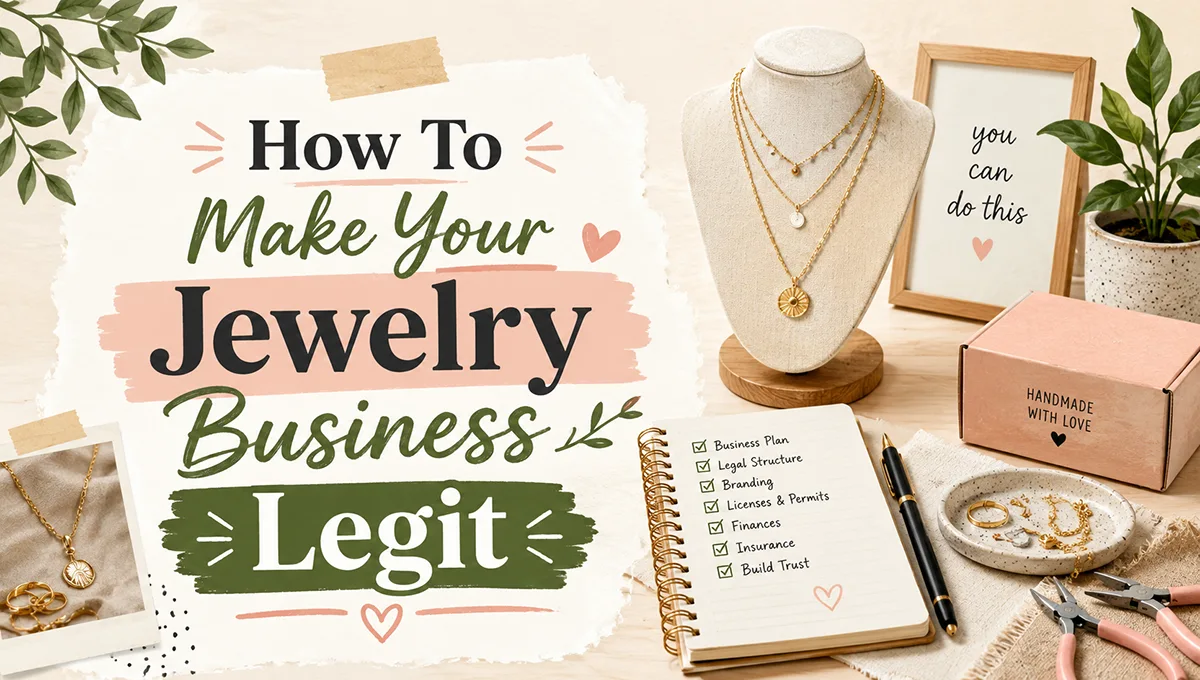
The Ultimate Guide to Legal Requirements for Selling Handmade Jewelry in Your State
You have spent countless hours perfecting your craft. You have mastered the art of beading, wire wrapping, or metal stamping. Your dining room table looks like a tiny workshop, and your friends keep asking, “Why aren’t you selling this?” The idea of turning your passion into a legitimate jewelry business is exhilarating.
But before you open your Etsy shop or sign up for that craft fair, there is a critical step that many creative entrepreneurs overlook: the legal landscape.
When starting a business that sells handmade jewelry, you are not just a crafter anymore. You are a manufacturer, a retailer, and potentially an importer of metals. The law views you differently than someone who sells a batch of cookies at a bake sale. Furthermore, because every state in the U.S. has its own unique set of tax laws, business regulations, and consumer protection statutes, there is no single “one-size-fits-all” answer.
This guide is designed to help you navigate the specific legal requirements for selling handmade jewelry in your state. We will break down the federal laws that apply to everyone, the state-specific variations you must look for, and the steps you need to take to protect yourself and your business.
Phase 1: The Foundation – Structuring Your Jewelry Business
Before you can legally sell a single earring, you must decide how the government sees your jewelry business. This is the first and most important legal decision you will make.
Sole Proprietorship vs. LLC for Handmade Jewelry
When starting a business, the easiest path is a Sole Proprietorship. There is no paperwork with the state, and you and the business are the same legal entity. This is great for a hobbyist selling a few pieces a year. However, if you are serious about scaling, this structure is risky. If a customer claims your handmade jewelry caused an allergic reaction or broke and injured them, they can sue you personally. Your car, your house, and your savings are all on the line.
A Limited Liability Company (LLC) is the gold standard for a jewelry business. It creates a legal wall between you and your business assets. While you have to pay a filing fee to your state (usually between $50 and $500), the protection is invaluable. If you are starting a business with a partner, an LLC is highly recommended to define ownership and responsibilities.
Registering Your Business Name (DBA)
If you are operating under a name that is not your legal full name (e.g., “Silver Moon Designs” instead of “Jane Doe”), you likely need to register a “Doing Business As” (DBA) name. This is done at the county clerk’s office or the state level, depending on where you live. This ensures that the public knows who owns the jewelry business.
Getting an EIN from the IRS
Even if you are a sole proprietor, getting an Employer Identification Number (EIN) from the IRS is smart. It allows you to open a business bank account, which is crucial for tracking expenses for your handmade jewelry supplies. It also protects your Social Security Number from being printed on invoices.
Phase 2: State-Specific Business Licenses and Permits
This is where the “in your state” part of our topic becomes critical. The federal government does not issue a general “business license.” Your state, county, and city do.
The General Business License
Most cities or counties require a general business license to operate legally. This is usually a simple form and a small annual fee. Starting a business from home? Check your local zoning laws strictly. Some residential areas prohibit signage, customer traffic, or inventory storage beyond a certain size.
The Seller’s Permit (Resale Certificate)
This is the single most important document for a jewelry business. Almost every state requires a Seller’s Permit (also called a Sales Tax Permit or Resale Certificate).
• Why you need it: It allows you to collect sales tax from your customers and remit it to your state. It also allows you to buy supplies (like beads, wire, and clasps) wholesale without paying sales tax, because you are the one who will eventually pay the tax to the end consumer.
• State Variations: The rules vary wildly. For example, if you live in Oregon, Montana, Delaware, or New Hampshire, there is no state sales tax (though local taxes may apply).
• The “Nexus” Problem: Many makers sell at craft shows in other states. If you travel to a neighboring state for a weekend show, you usually need a temporary seller’s permit for that state. You cannot use your home state permit everywhere.
Home Occupation Permits
If you are running your jewelry business from a kitchen table or spare bedroom, your city may require a Home Occupation Permit. This ensures your business does not disrupt the residential character of your neighborhood. Some states have strict rules about storage of flammable chemicals (like pickle or patina solutions).
Phase 3: Specific Legal Requirements for Handmade Jewelry Materials
This is the most technical section for a handmade jewelry artisan. Because you are making products that touch the skin, the law is strict.
Metal Stamping and the “Fineness” Law (Hallmarking)
If you sell handmade jewelry made from precious metals (gold, silver, platinum, palladium), you are subject to the National Stamping Act in the U.S.
• The Law: You cannot simply stamp “Sterling” on a piece of silver unless it is 92.5% pure. You may be required to stamp your maker’s mark (a trademark or initials) next to the fineness mark (e.g., “925,” “14K”).
• State Variations: Some states are more aggressive than others in enforcing this. In California, laws regarding metals in children’s jewelry are incredibly strict. In New York, there are specific consumer protection laws regarding the “quality mark” of handmade jewelry. If you buy pre-made tags or charms that say “Sterling,” you must be able to prove they are genuine. You, as the seller, are liable.
Lead and Cadmium Laws (California Proposition 65)
This is a massive issue for any jewelry business selling in the United States, but it originates from California.
• What it is: Proposition 65 requires businesses to warn consumers if their products contain any of over 900 listed chemicals known to cause cancer or birth defects. Lead and cadmium are common in cheap metal findings, colored glass, and some solders.
• The Reality: If you sell handmade jewelry to a customer in California, either online or at a show, you must comply. The penalties for non-compliance can be severe (up to $2,500 per violation per day). Many small makers now stamp “WARNING: This product contains chemicals known to the State of California…” on their packaging just to be safe, even if they use lead-free brass.
• Check Your Findings: As you are starting a business, switch to “nickel-free” and “lead-free” components. This is not just a good marketing point; it is a legal shield.
The Federal Trade Commission (FTC) Guides for Jewelry
The FTC has specific rules about how you can describe handmade jewelry.
• “Handmade”: You can only call it handmade if you physically made it by hand or with hand tools. If you bought beads from a factory and strung them, it is “hand-assembled” or “hand-strung.”
• “Vermeil”: This means a specific thickness of gold over sterling silver. You cannot call a gold-plated brass piece “Vermeil.”
• “Rose Gold”: This is an alloy of gold and copper. If you are selling a base metal piece that is just rose colored, you cannot call it “Rose Gold.”
Phase 4: Sales Tax – The Most Confusing Part of the Jewelry Business
Sales tax is a nightmare for many artists, but understanding it is vital.
Physical Nexus vs. Economic Nexus
Historically, you only collected sales tax in states where you had a physical presence (your home, a shop, a warehouse). After the South Dakota v. Wayfair Supreme Court decision, states can now require you to collect sales tax based on economic presence.
• Check your state’s threshold: Most states require you to collect tax if you make over 200 transactions or $100,000 in sales in that state in a calendar year. If you are a small maker just starting a business, this likely only applies to your home state for the first year. However, if you blow up on Instagram, you must watch this limit.
How to Collect and Remit
• In-State Sales: When you sell handmade jewelry at a local craft fair, you must charge the sales tax rate of the location where the sale takes place. This can be the city or county rate, not just the state rate.
• Out-of-State Sales (Shipping): You charge sales tax based on the shipping destination. You usually remit this to that specific state.
• Using a Platform: If you sell on Etsy, they handle the calculation and collection of sales tax for orders shipped to certain states. However, they do not handle the remittance for you in all states. You still must file a tax return for those states.
Note: This is the area where most small jewelry business owners get into legal trouble. Investing in an accountant or bookkeeping software that handles “Sales Tax Nexus” is highly recommended when starting a business.
Phase 5: Intellectual Property – Protecting Your Handmade Jewelry Designs
Your original creations are your most valuable asset. The law offers several ways to protect them.
Copyright
Copyright protects original “works of authorship.” In the context of handmade jewelry, this protects the design itself—the specific pattern of a wire wrap, the shape of a unique charm, or the layout of a bead weave.
• The Catch: Copyright does not protect functional items. So, a simple string of pearls (a functional necklace) is not copyrightable. A specific, complex, artistic wire-woven pendant is.
• Formalities: While copyright exists the moment you create the piece, registering it with the U.S. Copyright Office is necessary if you ever want to sue someone for copying your design.
Trademarks
A trademark protects your brand identity—the name of your jewelry business, your logo, and your tagline.
• Why it matters: It prevents another maker from starting a jewelry business under a name that is confusingly similar to yours.
• State vs. Federal: You can register a trademark at the state level (cheaper, but only protects you in that state) or at the federal level (national protection, much stronger).
Design Patents
For a unique, ornamental design for a piece of handmade jewelry (like a specific shape for a clasp or a unique bezel setting), you can apply for a design patent. This is expensive ($1,000–$3,000) and takes time, but it offers 15 years of protection.
Phase 6: Insurance – Why You Need It Immediately
Many solo makers skip insurance because of the cost. This is a mistake.
General Liability Insurance
This covers you if a customer slips on a bead at your booth or if a necklace breaks and damages their clothing. It also covers product liability.
• Product Liability: This is the big one. If a customer breaks out in a rash from your handmade jewelry or chokes on a broken component, they can sue you. Liability insurance will pay for your legal defense and any settlement.
• Cost: For a small jewelry business working from home, a general liability policy can cost as little as $250–$400 per year through specific artisan insurance programs.
Inland Marine Insurance (Property Coverage)
If you attend craft fairs or ship handmade jewelry, your homeowner’s insurance likely does not cover your inventory. “Inland Marine” insurance covers your supplies and finished goods while they are in transit or at a show.
Phase 7: Labeling and Packaging Requirements
The law requires specific information on your packaging, especially for handmade jewelry.
Country of Origin Labeling
If you import any components from other countries (glass beads from Czechia, gemstones from Brazil, clasps from China), the final product is “U.S. Made” if the substantial transformation (assembly) happens here. However, if you sell finished beads or findings that are imported, they must be labeled with the country of origin.
Content Labelling
At a minimum, you should label your handmade jewelry with:
• The metal content (e.g., “Brass,” “Sterling Silver,” “Gold-Filled”).
• The gemstone type (e.g., “Amethyst,” “Pink Tourmaline”).
• Care instructions.
• Your business name.
Children’s Jewelry (CPSIA Compliance)
This is the most strictly regulated area. The Consumer Product Safety Improvement Act (CPSIA) applies to handmade jewelry designed for children 12 and under.
• Lead Limits: The lead content in any accessible part of children’s handmade jewelry must be below 100 ppm (parts per million).
• Phthalates: Certain chemicals in plastics and coatings must be below limits.
• Tracking Labels: You must have a permanent label on the product with a unique code that allows the product to be traced back to the date and place of manufacture.
• Testing: You may be required to have third-party testing for lead content if the product is intended for children. If you are starting a business that focuses on children’s jewelry, this is a non-negotiable cost.
Phase 8: Your State’s Specific Craft Fair and Flea Market Laws
Many states have specific laws regarding “transient merchants” or “itinerant vendors.”
• Registration: Some states require you to register with the state’s Department of Revenue if you plan to do a circuit of craft fairs.
• Bonding: A few states (like Illinois and New York) have historically required a bond for out-of-state sellers.
• Local Health Permits: If you sell handmade jewelry that can double as a toy or a food holder, local health departments may get involved.
Action Step: Search for “[Your State] Transient Merchant License” or “[Your State] Arts and Crafts Show Vendor Requirements.” This will tell you exactly what forms are needed to sell at an event.
Phase 9: A Checklist for Starting a Jewelry Business Legally
To summarize the legal requirements for selling handmade jewelry in your state, here is a step-by-step checklist:
• Choose a Business Structure: Decide Sole Proprietor or LLC. Form an LLC with your Secretary of State.
• Register Your Name: File a DBA if your business name is different from your personal name.
• Get an EIN: Apply for free on the IRS website.
• Get a Business License: Check your city and county clerk’s office.
• Get a Seller’s Permit: Visit your state’s Department of Revenue website. This is crucial for starting a business with sales tax compliance.
• Research Prop 65: If you sell in California, prepare your warnings.
• Review Metal Stamping Laws: Ensure your silver and gold marks are accurate and include your maker’s mark if required.
• Purchase Insurance: Get a general liability policy for product liability.
• Create Formal Labels: Include metal content, gem identification, and care instructions.
• Check Children’s Jewelry Laws: If you make items for kids, invest in a lead-testing kit or third-party testing.
• Set Up a Sales Tax System: Use software or a spreadsheet to track sales by state and local jurisdiction.
• Draft a Terms of Service and Return Policy: This is a legal document for your website. Specify your refund policy for handmade jewelry (many makers do not accept returns due to hygiene).
Common Questions About Legal Requirements for Handmade Jewelry
Do I need a business license to sell handmade jewelry on Etsy?
Yes, technically. Etsy is a marketplace, but you are the seller of record. Most cities and states require a business license regardless of the selling platform. Etsy may handle sales tax collection in some states, but you still own the legal entity. Ignoring a business license could lead to fines from your local municipality.
Can I sell handmade jewelry from home without a permit?
It depends on the state and city. In most major cities, a “Home Occupation Permit” is required. In rural areas, it may be much more relaxed. However, you generally still need a Seller’s Permit to collect tax. Selling from home without a permit is considered starting a business on shaky legal ground.
What metals can I use legally for handmade jewelry?
You can use any metal, but you must describe it accurately. The biggest legal issue is lead content. Use “nickel-free” and “lead-free” base metals (like brass, copper, and sterling silver) to avoid future health-related lawsuits. Avoid importing unknown pot metals from overseas.
Is hallmarking my handmade jewelry mandatory?
If you are selling an item as “Sterling Silver” or “14K Gold,” then yes, a quality mark (925 or 14K) is generally required by federal law (the National Stamping Act). If you sell it as simply “white metal” or “base metal,” no hallmark is legally required, but a maker’s mark is always a good idea for branding.
How do I handle sales tax for an online jewelry store?
For an online store, you collect sales tax based on the shipping address of the buyer. You must be registered in the states where you have “nexus.” If you are starting a business, you likely only have nexus in your home state until you reach the economic thresholds of other states.
The Final Verdict: Don’t Fear the Law, Use It
When starting a business built around handmade jewelry, the legal requirements can seem daunting. They are not designed to stifle your creativity; they are designed to legitimize your craft. Getting a Seller’s Permit makes you a professional. Forming an LLC shows you are serious. Labeling your metals accurately builds trust.
Take it one step at a time. Start with your business license and Seller’s Permit. Then, move to your labeling. Finally, update your policies.
The most expensive mistake you can make is assuming that because your jewelry business is small, the law does not apply. A single dispute with a customer or a state audit can cost you more than all the supplies you will buy in a year. Do the paperwork now, so you can focus on what you love: creating beautiful handmade jewelry.
Are you ready to take the next step in your jewelry business journey? What legal hurdle feels the most confusing to you right now?
──────────────────────────────────────────────────
Note From Editor: This article is intended for informational purposes and does not constitute legal advice. Laws change frequently. It is essential for the reader to consult with a local attorney or tax professional for their specific situation.